-
Membership
-
- Conferences
-
Informal Curriculum (CLD)
Complex Learning Difficulties (CLD)
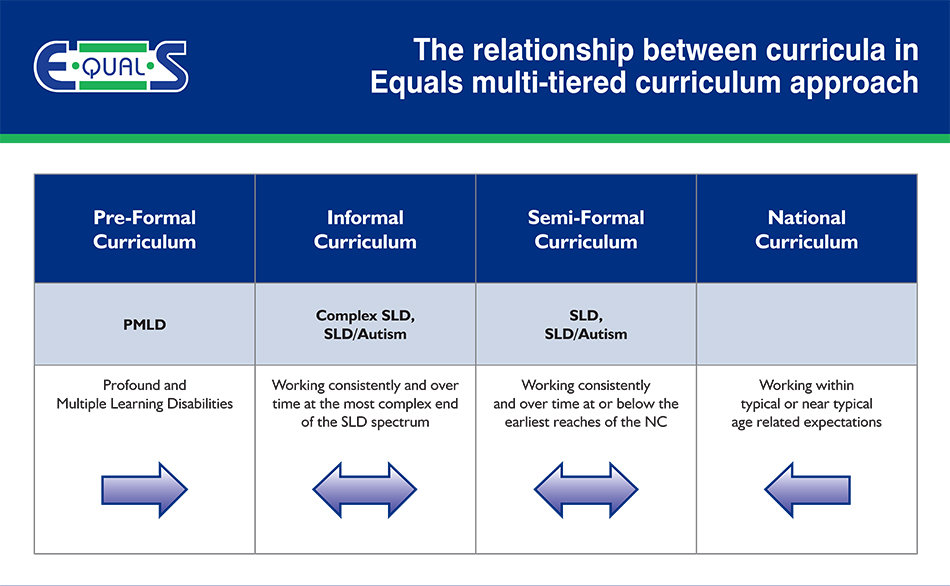
The Equals Informal Curriculum is set in the context of Equals multi-tiered curriculum approach, recognising that differentiation from England’s (or indeed any) National Curriculum is NOT sufficient to meet the needs of pupils and students with profound, complex, severe or global learning difficulties.
For pupils who are all working consistently and over time below or very near the start of their national curriculum, curricula NEED TO be different rather than differentiated, because the way such pupils learn is different, and often very, very different from neuro-typical, conventional developing learners for whom the national curriculum was designed.
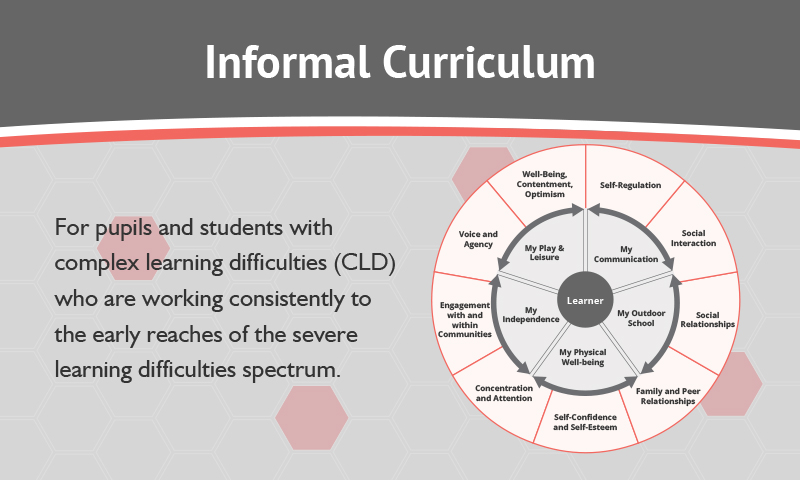
Those with Complex Learning Difficulties (CLD) have all of the defining difficulties we might regard the term SLD as encompassing, noted by Imray and Colley (2017) as;
- Communication difficulties
- Difficulties with abstract concepts
- Difficulties in concentration and attention
- Difficulties with both short term and long-term memory
- Difficulties with sequential memory
- Difficulties with working memory
- Inefficient and slow information processing speed
- Insecure general knowledge
- Poorly developed strategies for thinking and learning
- Difficulties with generalisation and problem solving
Breadth and Balance
Whilst we accept the desirability of providing a broad and balanced curriculum, it must be wholly appropriate to the needs of each learner. Ongoing assessment may point to a need for concentration and intensity in one or two particular areas for some learners for a part, and sometimes a considerable part of their time in education.
Education SHOULD NOT and must not be tokenistic just for the sake of ticking a box. For those with CLD, time in education is LIMITED and PRECIOUS, and we are duty bound not to waste it.

Classroom Organisation
An essential part of ENGAGEMENT is to recognise that the complexity of their learning difficulties will mean that such learners do not, and cannot learn effectively when taught in a compartmentalised and piecemeal manner (Ware, 2003; Welsh Assembly Government, 2006; Lacey, 2010; Imray and Hinchcliffe, 2014; Imray and Colley, 2017).
In practice this means that we have to aim for as much consistency and continuity as possible, not just in what we teach, but how we teach and who is doing the teaching. With this in mind, we strongly recommend that the school organises its days around specific Class Groups taught by the same core staff of Teacher and TAs, and seeks to hold these Class Groups together over time.
Frequently Asked Questions
-
Is there an online CPD session for the Informal-formal Curriculum (CLD)?
Yes. There is a live session where professionals can also ask questions. For details for all future virtual CPD Sessions please visit the Equals events section.
-
Are there any schools we can visit to share best practice?
Equals works with other schools to help share good practice. Members secure opportunities to spend a day in such schools and listen to their own journey in regards to curriculum and assessment. Please visit the In-Person Development Days page for further information.
-
Can we edit the documents in Microsoft Word for our own school use?
Yes. This curriculum is provided electronically as a PDF and a Microsoft Word File. Schools can edit this themselves for use within their own school. Schools cannot then sell this resource, but can adapt and evolve it to match the needs of their own school and pupils.
Are you an Equals Member?

- Conferences
-